Structure of the Month

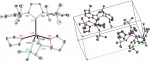
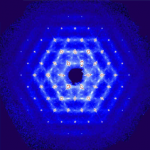
There is some really cool chemistry done in the Chemistry Department and some even cooler structures. So, the Oxford Chemical Crystallography Service runs a  “Structure of the Month” competition to show-case some of the best examples. The monthly winners are displayed at the entrance to the X-ray lab and details are given below once the material has been published.

Structure of the Month - January 2012

Presented by: Dr. Andrew D. Schwarz
Research Leader: Prof. Philip Mountford
Published: Chemical Science

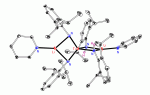
Inspired by the development of high-energy, early transition metal-ligand multiply-bonded systems, we targeted the unprecedented classes of bis(imido) and tris(imido) compounds of the group 4 metals (to give the first example of a group 4 metal simultaneously containing two or three … Read the rest

Structure of the Month - November 2011

Presented by: Matthew P.Blake
Research Leader: Prof. Philip Mountford
Published: Journal of the American Chemical Society

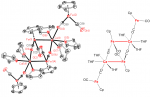
Metal-metal bonded molecular compounds have been an essential part of development in inorganic chemistry for decades; research has been reenergized by the discovery of the first Cr-Cr quintuple-, Zn-Zn single- and Mg-Mg single bonds. However, within this rich and … Read the rest

Structure of the Month - September 2011

Presented by:  Andrew B. Cairns & Amber L. Thompson
Research Leader:  Dr. Andrew L. Goodwin
Published:  Journal of the American Chemical Society (cover article)

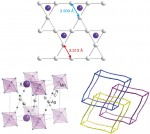
Negative Linear Compressibility (NLC) is where a material unusually expands in one direction under increasing pressure.  Potassium manganese dicyanoargentate exhibits the largest NLC over an extended range of any known material: … Read the rest

Structure of the Month - June 2011

Presented by:  Matthew J. Langton, Jonathan D. Matichak & Amber L. Thompson
Research Leader:  Prof. Harry L. Anderson
Published:  Chemical Science (cover article)

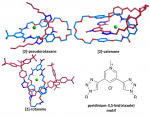
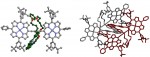
Fully π-conjugated porphyrin oligomers exhibit remarkable properties such as ultrafast energy migration, strong two-photon absorption and wire-like charge transport. The possibility to encapsulate them by rotaxane formation may provide valuable control over … Read the rest

Structure of the Month - May 2011

Presented by:  Matthew Tatton & Paul Winship
Research Leader:  Prof. Timothy J. Donohoe
Published:  Angewandte Chemie International Edition

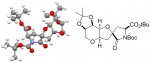
This is the final isolated intermediate in the synthesis of Neodysiherbaine A;  crystals were very small, so data were collected on I19 at Diamond.  The natural product is an excitatory amino acid isolated from the Dysidea herbacea … Read the rest

Structure of the Month - February 2011

Presented by:  Andrew D. Schwarz & Liban M. A. Saleh
Research Leader:  Prof. Philip Mountford & Prof. Simon Aldridge
Published:  Journal of the American Chemical Society

Transition-metal boryl compounds (L)M(BX2)x, containing 2‑center, 2‑electron σ‑bonds have been a topic of outstanding interest due to pivotal roles in … Read the rest

Structure of the Month - January 2011

Presented by:  Nicholas H. Evans & Christopher J. Serpell
Research Leader:  Prof. Paul D. Beer
Published: Angewandte Chemie International Edition

Catenanes and rotaxanes are highly attractive targets for the supramolecular chemist due to their potential uses as molecular machines or as selective hosts for ionic and molecular guests. This molecule was synthesised via chloride anion … Read the rest

Structure of the Month - December 2010

Presented by:  Adrian B. Chaplin
Research Leader:  Prof. Andrew S. Weller
Published:  Journal of the American Chemical Society

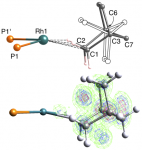
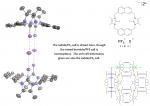
Making and breaking C–C bonds in the solid state:  The structure of [Ir(BINOR‑S)(PiPr3)][BArF4] over the temperature range 100–250 K reveals a dynamic equilibrium between Ir(III) C–C agostic and Ir(V) bis-alkyl tautomers … Read the rest

Structure of the Month - November 2010

Presented by:  Nicola K. S. Davis & Amber L. Thompson
Research Leader:  Prof. Harry L. Anderson
Published:  Journal of the American Chemical Society

Molecules with large planar π-systems show a strong tendancy to aggregate due to π-π interactions. This tetra-anthracene-fused porphyrin forms dimers with the molecules twisted with respect to each other. Bulky aryl groups … Read the rest

Structure of the Month - September 2010

Presented by:  Nathan L. Kilah, Matthew D. Wise, Christopher J. Serpell, Nicholas G. White, Kirsten E. Christensen & Amber L. Thompson
Research Leader:  Prof.
Paul D. Beer
Published:  Journal of the American Chemical Society

This structure represents the first use of solution phase halogen bonding to control and facilitate the anion templated assembly of an … Read the rest

© 2012 Chemical Crystallography Suffusion theme by Sayontan Sinha